SAMATVAYA / HEALTHY HOMES / INDOOR AIR QUALITY
We seal our homes against dust and pollution. But what happens to the invisible gas that can enter from the ground beneath them?
The unintended consequence of sealing our homes
In Indian cities, controlling dust, traffic emissions and construction pollution has become a major concern for homeowners. Tighter windows, door gaskets and air-conditioned rooms can improve comfort and reduce unwanted outdoor air infiltration. But airtight construction needs deliberate ventilation and pollution-source control. Otherwise, pollutants entering or generated indoors may accumulate.
One often-overlooked example is radon, a naturally occurring radioactive gas. Airtightness does not itself create radon, and not every sealed home has a radon problem. The risk depends on the ground beneath the building, available entry routes and indoor airflow.
What is radon, and how can it enter a home?
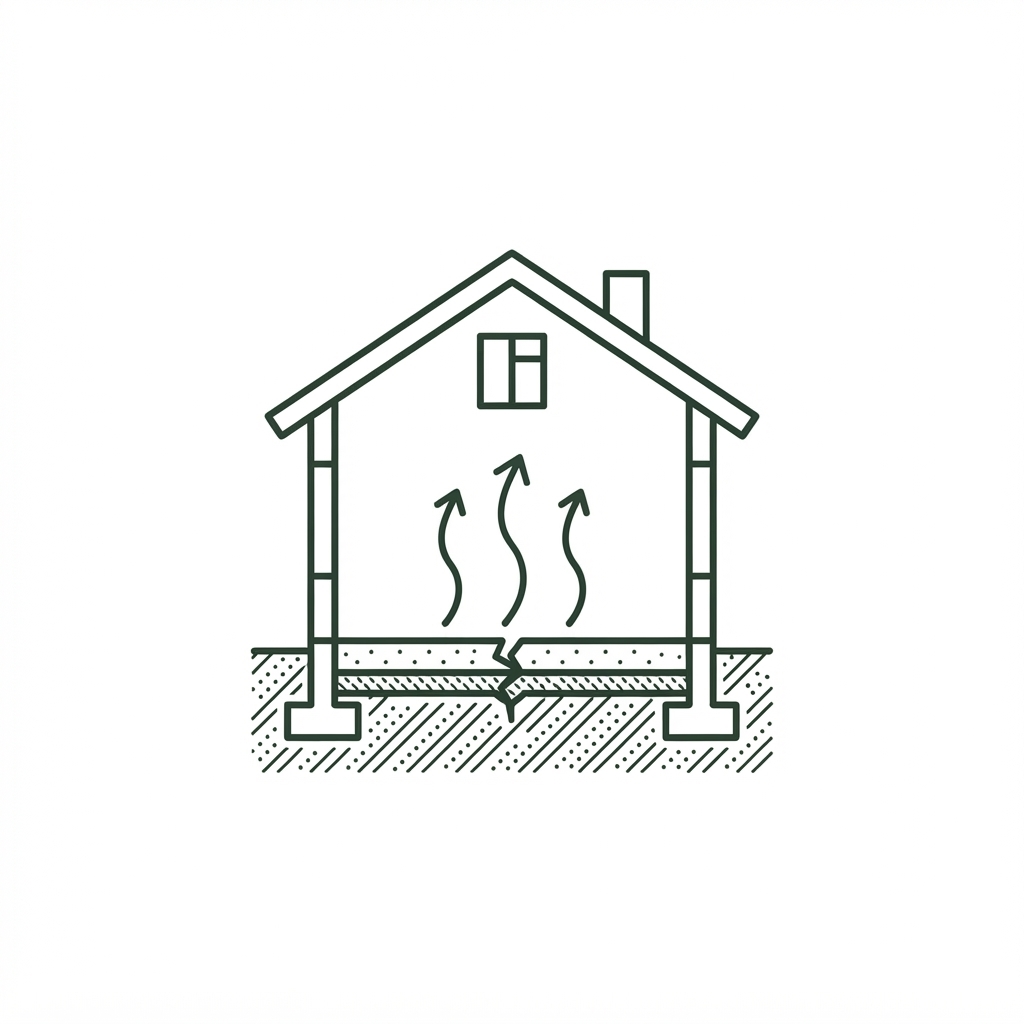
Radon forms naturally as uranium in soil and rock decays. It has no colour, smell or taste. Soil gases can travel through cracks in slabs, floor-wall junctions, service penetrations, sumps and other openings connected to the ground.
- Cracks in ground-contact floors and foundations
- Openings around pipes, cables and drainage connections
- Gaps at floor-wall joints and unfinished service penetrations
- Pathways from basements and other ground-contact spaces
Levels are often higher in basements and lower floors, but upper floors cannot be assumed immune. Local geology and building design matter.
Why is long-term exposure important?
The World Health Organization identifies radon as a major cause of lung cancer. Radon’s radioactive decay products can be inhaled and deposited in the airways, where radiation can damage cellular DNA. The established health concern is long-term lung-cancer risk, not an immediate symptom that announces the presence of gas. The risk is especially high in people who smoke.
What does the evidence say about India?
Indian researchers have documented indoor radon in multiple regions. A 2021 study across Karimnagar, Peddapalli, Jagtial and Rajanna Sircilla districts in Telangana recorded concentrations ranging from 7 to 457 Bq/m³ in its sampled dwellings. These results are specific to the study area: they do not establish a nationwide increase in radon or imply that every Indian home has elevated exposure.
An airtight home is not the same as a ventilated home

A standard split air-conditioner primarily recirculates indoor air. An ordinary particle air purifier cannot be relied upon to eliminate radon gas. Inadequate air exchange can contribute to buildup when radon is entering a home. Certain exhaust systems may also depressurize a building and increase soil-gas entry unless replacement air and pressure balance are considered.
The design goal is not to abandon airtightness. It is to protect the home from outdoor pollution while controlling internal sources and providing appropriate fresh air.
Design solutions: stop the gas before it enters
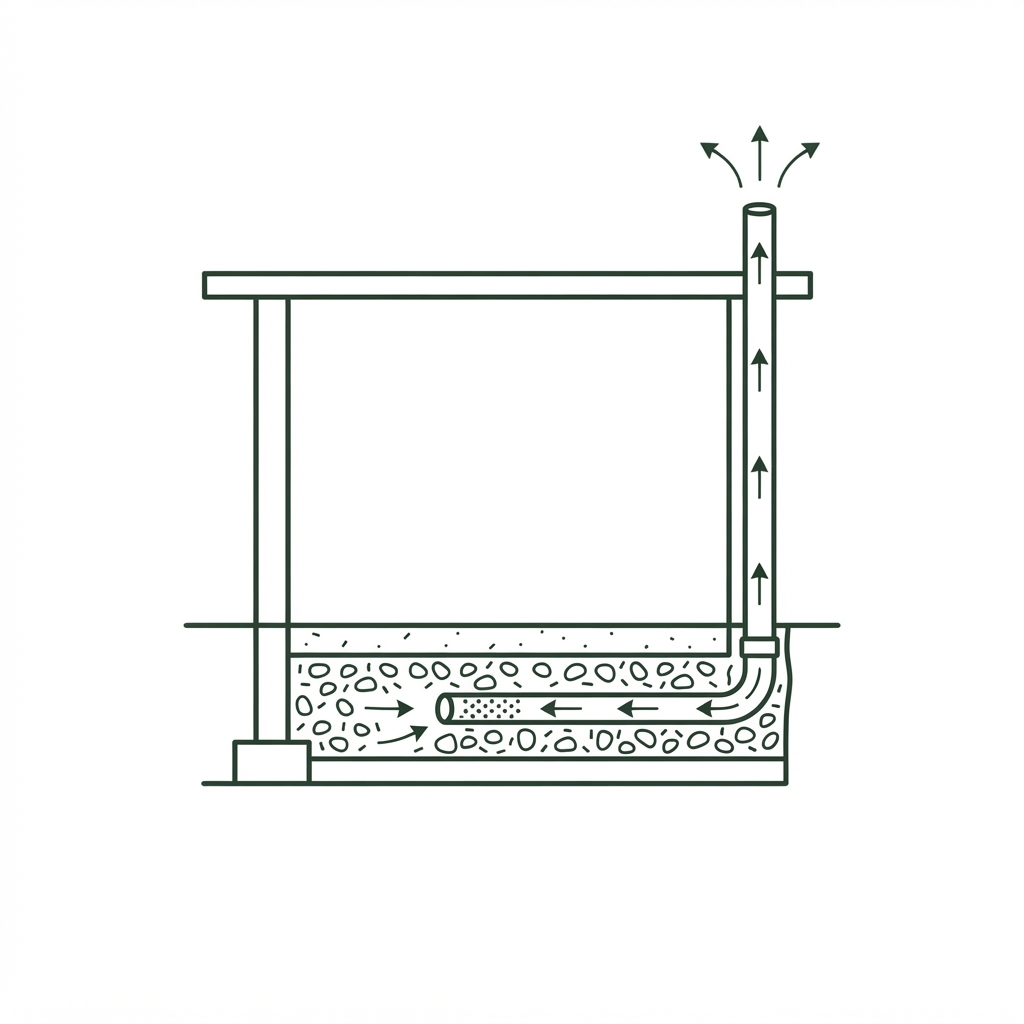
1. Plan radon-resistant foundations.
New construction can incorporate continuous ground-contact barriers, carefully detailed slabs, sealed penetrations and provisions for dedicated sub-floor soil-gas ventilation. Such details are easier to accommodate before finishes are installed.
2. Intercept soil gas below the slab.
Sub-slab depressurization uses dedicated suction piping and, when required, a fan to draw soil gas from beneath the floor and discharge it safely outdoors. For many foundation types, this is an established mitigation approach.
3. Seal entry pathways.
Appropriate sealing of cracks, joints, service routes and sump openings supports mitigation, but sealing alone should not be presented as a complete solution.
4. Design controlled ventilation.
Balanced mechanical fresh-air supply and extraction, with suitable filtration of incoming outdoor air, can support indoor air quality. The effect on radon depends on building conditions; fresh-air ventilation is not an automatic substitute for source-specific mitigation.
5. Consider pressure balance.
Kitchen hoods, bathroom extractors and other exhaust systems need adequate make-up air. Poor pressure balance can worsen soil-gas entry in some buildings.
What about apartments?
Basements, occupied ground floors and rooms with direct ground contact deserve particular attention. In multistorey buildings, lifts, shafts and service penetrations can also influence air movement. Appropriate solutions depend on the building’s foundation and mechanical systems and may require coordination between the architect, structural engineer, building-services designer and qualified radon-mitigation professional.
Beyond aesthetics: healthier homes are engineered
A healthy interior is not defined only by attractive materials, efficient cooling or an air purifier. It also depends on where pollutants originate, how they move and how they leave. Homes can be protected from outdoor dust without ignoring invisible hazards from below.
We should design for both.
Beyond Aesthetics — The Science of a Healthier Home.
Further reading
- World Health Organization — Radon and health
- US EPA — Consumer’s Guide to Radon Reduction
- Reddy et al. (2021) — Indoor radon in four northern Telangana districts
Educational article. Building-specific solutions should be designed by appropriately qualified professionals.
Leave a Reply